Keepsake Clearances

HomeGuidesWhere things go

Where things go, after they leave a Balmoral house

Landfill is the last stop, not the plan.

Two very different people ask us this question. One is watching a parent's household ride away in a van and wants to know it is not simply being dumped. The other has a dead fridge and a conscience, and wants the honest version, not a brochure. This page is for both of you, and it is the same answer: things go to the best next place that will actually have them, in a fixed order, and the tip comes last.

The order of it

Four stops, always in this order

Everything we carry leaves along the same fixed order. It is the same order for a deceased estate and for a dead fridge; the only thing that changes is how much of the load each stream claims.

  1. Family first

    Pieces promised to a granddaughter or wanted by a son are not waste at all: they are wrapped, labelled and delivered or held. This stream is decided by you, never by us.

  2. Donation second

    Sound furniture, books, linen and kitchenware are offered to charity while they still have a life to give, clean and working, never as someone else's problem.

  3. The regulated streams

    Metals to scrap, green waste to processing, e-waste and fridges to facilities licensed and equipped to take them. These streams are set by law, not preference.

  4. Landfill last

    Only what genuinely has no next place, taken to the tip with the fees already inside your fixed price. Never the first resort, never the whole van.

How the order survives

One load, several destinations

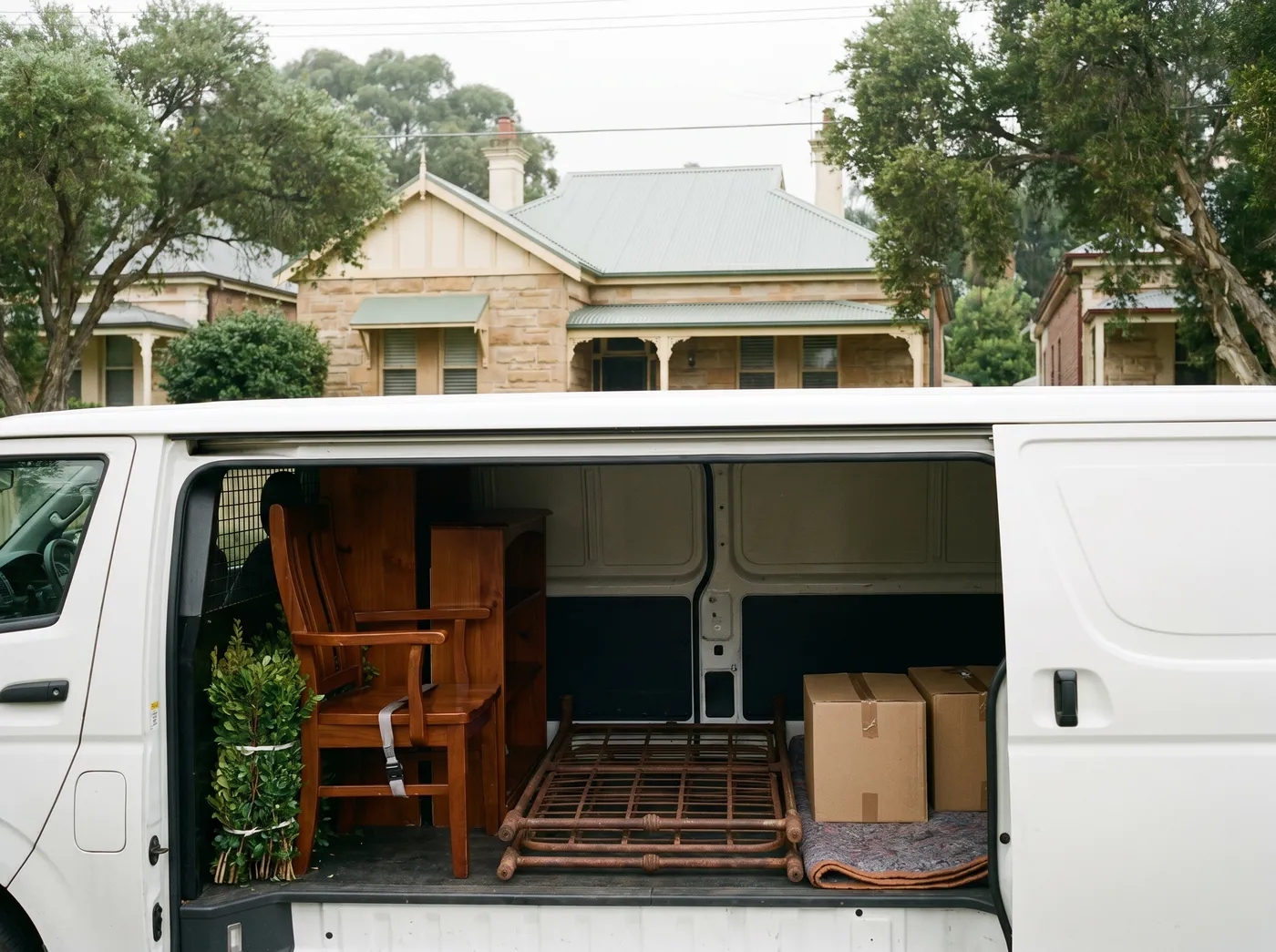
Nothing we carry leaves the suburb as one undifferentiated pile. The van is packed the way it will be unpacked: pieces worth another life kept apart and padded, the regulated streams kept separate, and only what is genuinely spent riding as rubbish. You can see the order in the van before it turns the first corner.

There is a reason we can afford to work this way and some crews cannot. A crew on an hourly rate is quietly paid to take the fastest route, and the fastest route is always the tip. Our price is settled before the van is loaded, so the extra stops cost you nothing and cost us only the driving. The order survives because the pricing model protects it.

The sorting happens at the house, not at the gate of the tip.

The open rear of a plain white van packed in tidy separated sections: strapped timber chairs and a small bookshelf, a tied bundle of hedge trimmings, a folded rusted iron bed frame and taped cartons, a leafy street of Federation houses behind
One van, packed the way it will be unpacked.
Stream by stream

What actually happens to each kind of thing

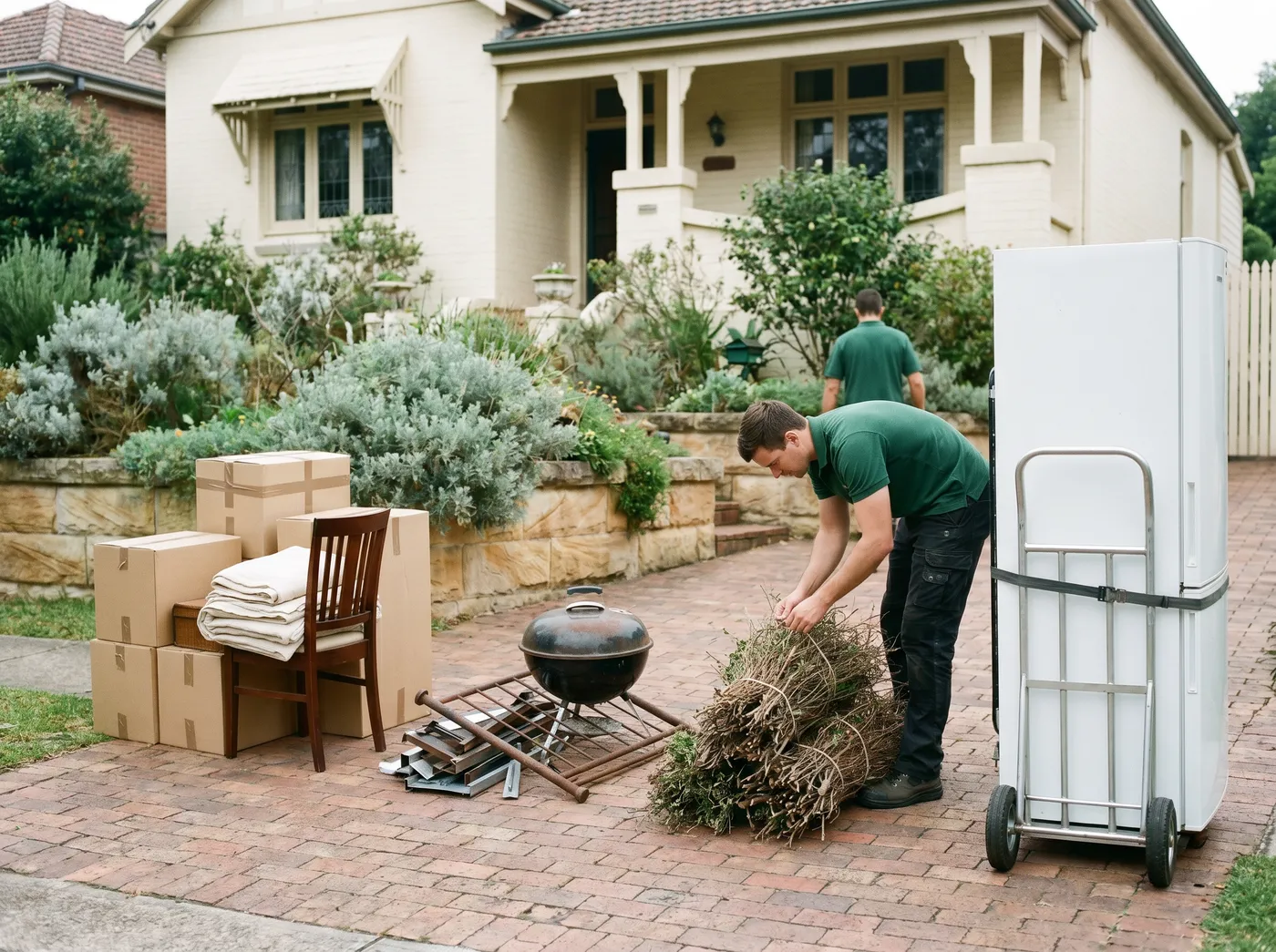
The honest answer is different for a sideboard and for a mattress, so here it is by stream. This is the full version of the short table on the pickup page: what each stream needs, where it goes, and where the free alternatives genuinely beat us.

The contents of a garage staged on a brick driveway in four separated groups: taped cartons and folded linen beside a timber chair, a small stack of scrap metal with an old barbecue, a tied bundle of hedge trimmings being knotted by a crew member, and a fridge strapped upright to a hand trolley
Sorted at the house, before the van is loaded.

Good furniture, books and kitchenware

A dining setting with life left in it is not rubbish, and it is not treated as rubbish. Whatever the family has not claimed is offered to charity: clean, sound and working, because charities can only pass on what someone can genuinely use, and leaving a broken lounge on their dock just makes our load their problem.

The route: family, then charity. What both decline moves down a stream, never onto a footpath.

Fridges, freezers and whitegoods

The refrigerant gas is the whole issue with a fridge: it must be professionally recovered before the metal can be recycled, so fridges travel to facilities equipped to degas them, and the steel then joins the scrap stream. It is also why the council cleanup will only take a fridge that is already degassed with its doors off. The gas has to be dealt with by somebody, and that somebody is never the kerb.

The route: degassing first, then scrap-metal recycling.

E-waste: TVs, computers, printers, cables

Screens, computers and their tangle of cables carry metals worth recovering and materials that do not belong in the ground, so they go to a licensed e-waste facility. If e-waste is all you have, Mosman Council runs free e-waste drop-off days that beat paying anyone, us included.

The route: a licensed e-waste facility, every time.

Metals: bed frames, barbecues, rusted settings

Scrap recycling, almost without exception. Rust does not disqualify steel: the outdoor setting the salt air ruined, the swing set, the bed frame from the under-house, all of it goes around again as metal rather than lying in landfill.

The route: the scrap yard, rust and all.

Green waste

Balmoral's established gardens produce serious volume: a season of hedge, a retaining wall's worth of clippings, the fig limbs that came down in the last southerly. It goes to green-waste processing to become mulch and compost, and it is never tipped as general waste just because the trailer was already headed that way.

The route: processing, into mulch and compost.

Textiles and clothing

Clean, wearable clothing and good linen are offered to charity, and a good winter coat does another winter for someone who needs one. We are honest about the rest: threadbare textiles have fewer good exits than any other stream, and stuffing them into a charity bin only moves the disposal bill onto the charity. What cannot be worn again is sorted out at the house and dealt with plainly, not offloaded onto a doorstep.

The route: wearable to charity; the rest handled honestly, not offloaded.

Mattresses

Mattress recyclers strip them back to steel, foam and fibre. Worth knowing before you book anyone: Mosman Council collects mattresses free at its scheduled cleanups and recycles them separately, which is unbeatable if your dates line up. The cleanup guide has the detail.

The route: a mattress recycler, or the council's free collection.

What is truly finished

Some of every long-held house is simply done: the perished foam, the water-damaged chipboard, the broken things past mending. It goes to the tip, at the end, with the fees already part of your fixed price. The honest service is taking it there without sending the good things along for the ride.

The route: landfill, last, and only what earned it.

The rules underneath it

In NSW, where waste goes is law, not preference

The streams on this page are not a courtesy we invented. Waste in New South Wales is regulated by the state's Environment Protection Authority, and under NSW law it is an offence to take waste to a place that cannot lawfully accept it. The responsibility rides with whoever carries the load: from the moment your things are on our van, where they end up is our legal obligation as much as our promise. The EPA's waste pages at epa.nsw.gov.au set out how the whole system works.

The same rules draw a line around what an ordinary clearance crew should carry at all. Three streams are not ours, and we name them at the walk-through rather than quietly loading them:

  • Asbestos, in any form, including the fibro sheet stacked under older houses. Licensed asbestos specialists exist for exactly this work, and we will point you to them.
  • Chemicals, paint in quantity and gas bottles, which need specialist collection programs, not a van. We can tell you what exists for these and clear everything else around them.
  • Clinical and medical waste, which has its own licensed chain.

One plain rule is worth carrying when you compare quotes: disposal costs real money, so a price that seems impossible has to make its savings somewhere. Asking any crew, ours included, "where will this actually go?" is a fair question, and it should get a plain answer.

Worth being straight about

The number we will not give you

Plenty of operators advertise a recycling percentage: eighty percent diverted, ninety, zero-landfill. We will not, because we do not weigh each job stream by stream, and a crew quoting a tidy number over the phone has certainly not weighed yours. A percentage invented to win your booking is not a green credential. It is a small first lie, and this business does not run on those.

What we give you instead is the order, kept every time, and the willingness to be asked. If you want to know where the sideboard went, or whether the books made it to the charity, ask: on an estate clearance the answer is usually already in the written record, and on a pickup we will simply tell you.

The promise is the order, not a percentage.

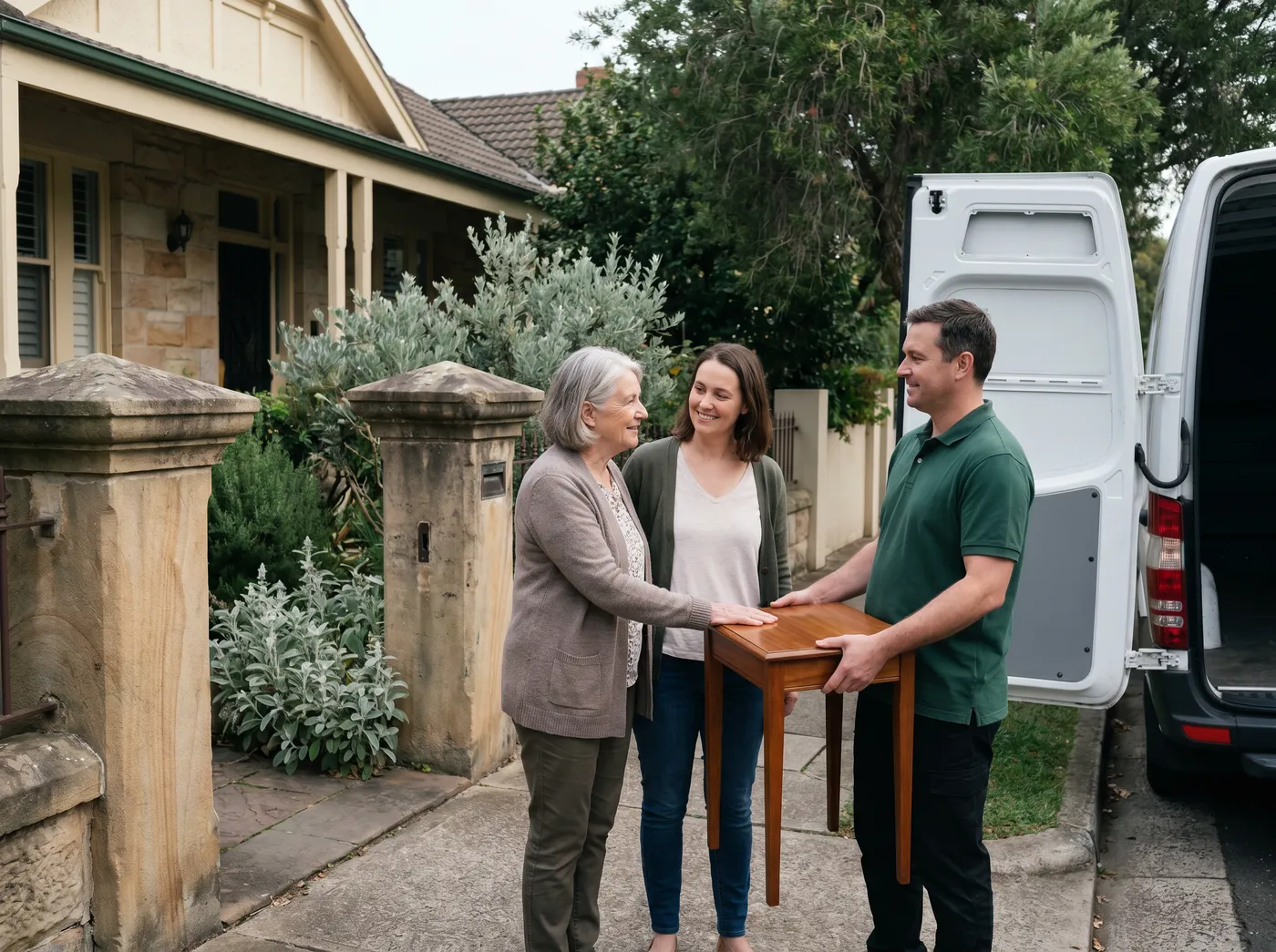
A crew member in a plain green polo steadies a polished timber side table at a sandstone front gate while an older woman rests her hand on it and her adult daughter smiles, the open white van waiting at the kerb
The best stream of all: a piece staying in the family.
On an estate

For a parent's house, the streams are gentler

When the house being cleared held a whole life, where things go stops being a waste question and becomes part of the farewell. The keepsakes are not a stream at all: photographs, letters and the things the family names never join the load, and the estate clearance page explains how the set-aside works.

For the rest, the same order does quiet good. The dresser goes to the granddaughter's first flat. The workshop's tools end up in hands that will use them. Families tell us this is the part that helps: not that the house was emptied, but that so little of what filled it was wasted.

And if something looks genuinely valuable, we stop and say so before it goes anywhere. We are clearers, not dealers: we do not buy, sell or take a margin on anything in the house, which is exactly why you can trust us to point it out.

Asked often, about where things go

Can you guarantee a recycling percentage for our job?

No, and we would be careful of anyone who can. What we guarantee is the order: family, donation, recycling and the licensed streams, and landfill only for what is left. On an estate clearance the written record shows where the significant things went.

Can our things go to a particular charity?

Tell us on the walk-through and we will do our best. We do not claim partnerships with any charity, and different stores accept different things on different days, so the honest promise is effort, not certainty: your preference goes into the plan, and if that charity cannot take something, we offer it to another before anything else happens.

Does donating things make the job cheaper?

The price is set at the walk-through, on the whole job as we see it, and the sorting is already assumed in it. What the donation streams change is what happens to your things afterwards, not the figure we agreed. If the job turns out genuinely smaller than we quoted, we say so, but that is about honesty, not a donation discount.

Would it be cheaper to just take everything to the tip?

For us, on the day? Sometimes. Tip fees are real, though, and so is the difference between a van of mixed waste and a van where the metal, green waste and donations have already found free or cheaper homes. The sorting is not charity on our part; it is simply the right way to run the work, and your fixed price already assumes we do it.

What about paint, chemicals and gas bottles?

They need specialist handling, and pretending otherwise is how people get hurt. We do not carry them; we can tell you which licensed collection programs exist for exactly these, and clear everything else around them.

Do you sell the things you take?

No. Nothing in your house ends up in a shop with our margin on it. Family first, charity second, recycling third: we make our living from the clearing, not the contents, and that is what keeps the advice honest.

More guides: the Mosman Council cleanup, plainly, clearing a house you can't attend, and the walkthrough, from first look to swept rooms.

Talk it through

Whenever you are ready

Tell us a little about the house, the move or the pickup. We will come back to you promptly, arrange a time to look, and agree the price before anything is lifted.

Make an enquiry